Interview: How ASAI and Apera AI Joined Forces to Raise the Bar for Vision-Guided Robotic Automation
In Europe’s automation world, breakthroughs usually arrive in small steps. But every so often, a partnership drops in that changes the rhythm. That is what happened when ASAI Industrial, a veteran integrator with nearly 25 years of automation experience, crossed paths with Apera AI, a company rewriting the rules of robotic vision with its 4D technology.
What began as a simple demo has grown into a strategic alliance that is reshaping how factories deploy bin picking and robot guidance systems. Today, ASAI views Apera as its go-to partner for vision driven automation, and the results are getting the industry’s full attention.
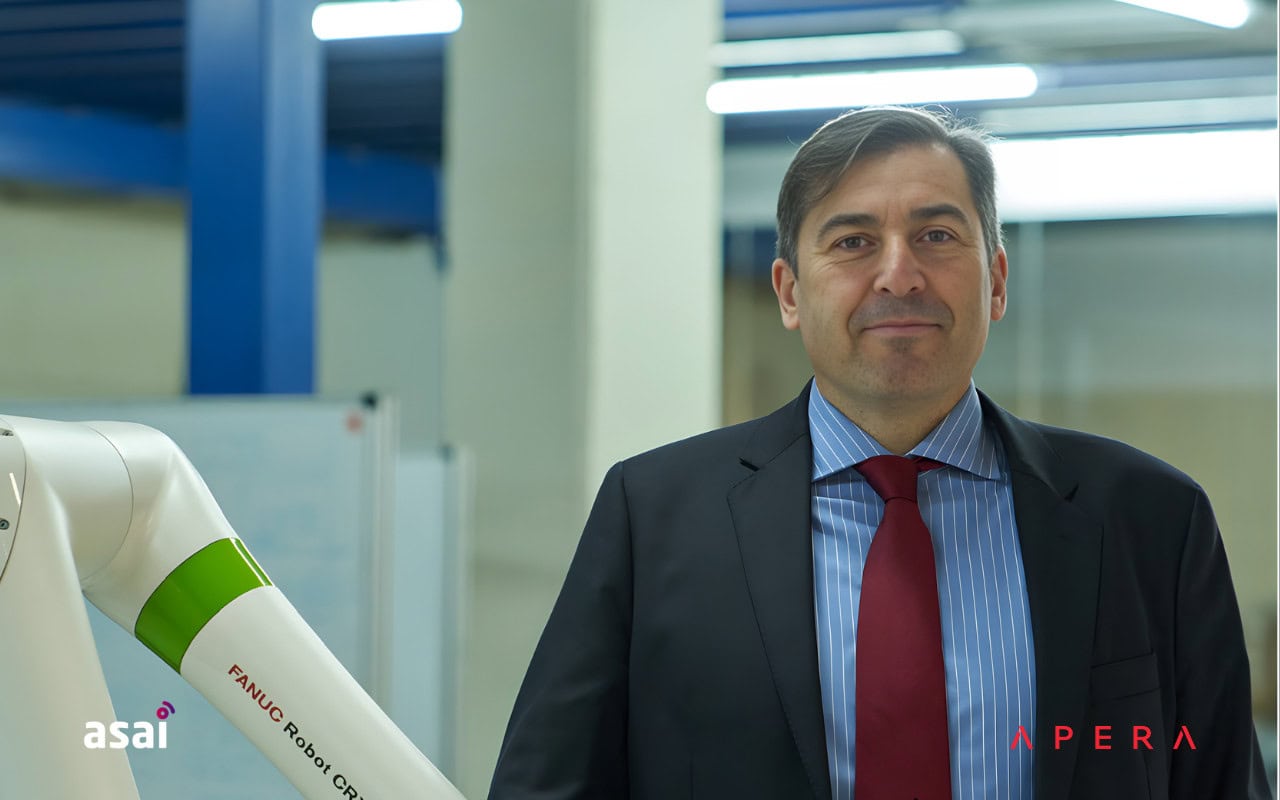
Below, ASAI Director General Adjunto and Deputy CEO, Juan A. Díaz, shares how the collaboration started, what makes Apera different, and where he believes this technology is headed.
Interview
For readers who don’t know ASAI, can you introduce the company and your role in Europe’s automation and robotics market?
ASAI is an engineering company focused on tailor made, turnkey automation projects. In a few months we will celebrate twenty-five years working with robotics, artificial vision, artificial intelligence, sensorics, PLCs, and software. To guarantee short lead times and full autonomy, we design and manufacture everything we need, from robot grippers to structures and tooling.
We have completed projects in twenty-two automotive plants and now operate across four continents. Our R+D+I division, Asai Innova, develops new products and methodologies with technological centers and companies like Stellantis, ArcelorMittal, and Seat-Volkswagen.
How did your journey with Apera AI begin, and what drew you to their technology?
A long-term customer introduced us to Apera after seeing their sister company in the United States use it successfully. They recommended ASAI as an integration partner. We arranged a demo of our facilities, and the results stunned us. We had tested many bin picking technologies, and it was obvious this was the one that stood above the rest.
What client challenges pushed you to explore Apera AI?
Lead time is crucial. Many bin picking systems are easy to set up but take weeks to reach stable, optimal performance. That level of uncertainty makes planning difficult. We needed a solution that removed those risks.
Among the options available, why did you choose Apera Vue and Apera Forge?
Because Apera brings predictability. With our current experience, we feel confident promising successful commissioning in only one week. It also brings several technical advantages: a strong simulation tool, simple setup of new parts, excellent cost efficiency when multiple cameras are needed, and an impressive ability to ignore lighting challenges.
How does Apera handle lighting changes, reflectivity, and random part orientation compared to others you’ve used?
Apera does not rely on expensive 3D cameras. Their 4D technology uses high resolution 2D cameras that thrive in harsh lighting and with reflective parts. The system is fast and precise. The performance is surprisingly very strong.
What makes Apera’s 4D Vision stand out?
Commissioning predictability is already a major advantage. But beyond that, Apera handles complex part behavior, multi-camera setups, and poor lighting conditions with a level of ease we had not seen before. Lighting independence alone is remarkable.
How important is Apera Forge’s simulation and training platform for you?
It is essential. Forge gives us clarity in minutes. We can identify challenges, test part interactions, and know exactly what to expect before investing time or resources. It reduces risk across the entire project.
Can you share a client case that reflects Apera’s impact?
Our first customer, a large multinational in the automotive sector, saw the demonstration and immediately purchased four systems. That decision reflects the strength of technology.
How would you describe your working relationship with Apera AI?
It is excellent. Our feedback is taken seriously, and the technical level on Apera’s side is very high. Every exchange is productive. For us and for our customers, this type of collaboration is essential.
What are your plans for expanding Apera AI solutions across industries and regions?
Apera is now our preferred choice for bin picking. It fits any industry. We invite customers and prospects to test their parts in our demo cell so they can see the system’s value firsthand. Since we work worldwide, our aim is to spread this technology as widely as possible.
Where do you see the biggest growth opportunities for AI driven robotic vision in Europe in the next few years?
Rack picking and bin picking have the largest potential. Beyond those, running quality check functions in parallel with robot guidance could create strong added value.
How do you see the ASAI–Apera partnership evolving?
We hope to help democratize Apera AI’s technology across Europe by showing customers its flawless performance. I also imagine a future where license models adapt to task difficulty, which would bring unprecedented flexibility and competitiveness. Apera has the potential to become a universal robot guidance solution. That is how powerful this technology is.
Raising the Bar for Vision-Guided Robotics
The ASAI–Apera AI partnership is transforming industrial automation in Europe. By combining ASAI’s 25 years of integration expertise with Apera’s 4D Vision, industrial manufacturers can now achieve predictable commissioning in one week—even in harsh lighting conditions or with complex parts.
This alliance proves that AI-driven vision can make bin picking, de-recking, and other robotic tasks fast, precise, and reliable. ASAI is bringing this technology to industries worldwide, positioning Apera AI as the go-to solution for 4D Vision-guided robotic automation.
Manufacturers in Europe, Morocco, Turkiye, or China: contact ASAI today to unlock the speed, precision, and performance of 4D Vision on your factory floor.